
Best Motherboards Under $400 in 2026: 14 Specs-Based Picks
The MSI MPG X870E Carbon WiFi takes the top spot among motherboards under $400 for AMD builders: it pairs the X870E chipset with DDR5 support, PCIe 5.0, and multiple M.2 slots, all on an ATX board. To choose the rest, we looked at the stated specifications of 18 motherboard listings priced under $400 and selected 14 that cover the main build types: desktop gaming, compact systems, NAS, and server workstations. Prices are live from the store listings; we have not run any of these boards.
14 picks from 9 motherboards that match this guide with a price we can quote today. The prices below are current and each carries its read time.
Quick picks
The best fit for you
- For esports on a budget: You want a new AM4 board that works with older Ryzen CPUs and cheap DDR4 memory, without spending extra on features you do not need. See pick 12
- For a compact home server: You need many SATA ports and a small footprint to build a high-capacity NAS that can run 24/7. See pick 9
- For a small form factor gaming PC: You want a mini-ITX board with current-gen AMD socket and future-proof DDR5 memory for a tiny but powerful build. See pick 4
- For a dual-socket workstation: You need to run two Xeon or Core processors in one machine for heavy virtualisation or rendering, and you accept an E-ATX board. See pick 8
Our 14 picks
1 Best overall
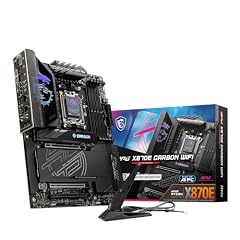
The MSI MPG X870E Carbon WiFi combines the flagship X870E chipset for AMD AM5 with DDR5 memory support and an ATX layout. It is the only board here with both PCIe 5.0 and Wi-Fi 6E in the seller's listing, making it a strong pick for a high-end gaming or productivity build.
Pros
- AM5 socket, supports Ryzen 9000/8000/7000 series
- DDR5 memory support
- ATX form factor with multiple M.2 slots
- Wi-Fi and PCIe 5.0 listed by seller
Cons
- No stated USB4 or Thunderbolt support
- Requires a CPU with integrated graphics for display output unless a GPU is used
Good fit if
- AMD builders who want a feature-rich board without overspending
- Gamers or creators planning to use Ryzen 7000/9000 CPUs
Skip if
- You already own DDR4 RAM and want to reuse it
- You prefer a smaller form factor than ATX
Verdict: The MSI MPG X870E Carbon WiFi offers the best all-around feature set for a modern AMD build at this price point.
2 Best for Intel gaming

ASUS ROG Strix Z890-E Gaming WiFi Intel® Z890 LGA 1851 ATX Motherboard
- Socket
- LGA1851
- Form factor
- ATX
- Memory type
- DDR5
$299.99 price as of 2026-10-07 05:30 UTC (Details)
Outside this guide's budget at today's price.
The ASUS ROG Strix Z890-E Gaming WiFi targets Intel Core Ultra desktop processors on the LGA1851 socket. Its 18+2+1+2 power stages, DDR5 support, and ATX layout make it a robust choice for overclocking and gaming, while the built-in Wi-Fi adds convenience.
Pros
- LGA1851 for Intel Core Ultra Series 2
- 18+2+1+2 power stages listed by seller
- DDR5 memory support
- Wi-Fi 7 listed in product name
Cons
- Newer socket means no compatibility with older Intel CPUs
- ATX size may be large for compact cases
Good fit if
- Intel gamers building with the latest Core Ultra desktop chips
- Users who want a high-phase VRM for overclocking
Skip if
- You use an AMD Ryzen processor
- You need a mATX or ITX board for a small case
Verdict: For an Intel Core Ultra gaming rig, the ROG Strix Z890-E is the most complete option in this list.
3 Best for Intel LGA1700 systems

GIGABYTE Z690 AORUS Ultra
- Socket
- LGA1700
- Form factor
- ATX
- Memory type
- DDR5
$340.19 price as of 2026-10-07 05:58 UTC (Details)
The GIGABYTE Z690 AORUS Ultra supports Intel 12th, 13th, and 14th generation processors on the LGA1700 socket. With DDR5, PCIe 5.0, quad M.2, and Wi-Fi 6, it covers everything a modern Intel desktop needs, and the ATX layout leaves room for expansion.
Pros
- LGA1700 with broad CPU compatibility
- DDR5 and PCIe 5.0 support
- Four M.2 slots and Wi-Fi 6
- 2.5GbE LAN for fast networking
Cons
- Uses the older Z690 chipset rather than Z790
- No USB4 listed
Good fit if
- Intel users upgrading from LGA1200 who want DDR5
- Builders who need multiple M.2 drives for storage
Skip if
- You plan to use a Core Ultra Series 2 CPU (needs LGA1851)
- You are on a tight budget and prefer a cheaper board
Verdict: A mature LGA1700 board with a strong set of ports and features for a wide range of Intel builds.
4 Best mini-ITX

ASUS ROG Strix X870-I Gaming WiFi AMD X870 AM5 DDR5 8400 HDMI 2xUSB4 2X
- Socket
- AM5
- Form factor
- ITX
- Memory type
- DDR5
$349.99 price as of 2026-10-07 05:30 UTC (Details)
The ASUS ROG Strix X870-I Gaming packs AMD X870 features into a mini-ITX board. It supports DDR5 up to 8400 natively (per seller), includes two M.2 slots, dual USB4, and Wi-Fi 7, making it the most connectivity-rich compact board in this price range.
Pros
- Mini-ITX size fits small cases
- USB4 dual ports (as listed)
- Wi-Fi 7 and 2.5GbE LAN
- DDR5 support up to 8400
Cons
- Only two M.2 slots, limited for many drives
- Small layout may complicate cable management
Good fit if
- Users building a compact gaming or HTPC system
- Those who want Thunderbolt-like USB4 in an ITX board
Skip if
- You need more than two M.2 or many SATA ports
- You prefer a larger board with more expansion slots
Verdict: The best small form factor AMD board in this guide, with a rare mix of USB4 and Wi-Fi 7.
5 Best for AI tasks

GIGABYTE B850 AI TOP AMD AM5 ATX Motherboard
- Socket
- AM5
- Form factor
- ATX
- Memory type
- DDR5
$329.00 price as of 2026-10-07 05:58 UTC (Details)
The GIGABYTE B850 AI TOP is an ATX AM5 board with a 16+2+2 power phase design and DDR5 support. Despite its name, it does not include a dedicated AI accelerator, but the robust VRM and modern chipset make it a stable base for multi-GPU or compute loads.
Pros
- 16+2+2 power phases support high-end Ryzen CPUs
- AM5 with DDR5 and PCIe 5.0
- ATX layout with three M.2 slots (from seller's description)
- Supports Ryzen 9000/8000/7000 series
Cons
- No USB4 or Thunderbolt
- No built-in Wi-Fi (not mentioned in seller name)
Good fit if
- Users running AI inference or machine learning workloads on a budget
- AMD enthusiasts who want a solid mid-range X870 alternative
Skip if
- You need Wi-Fi or Bluetooth without adding a card
- You want the full X870E feature set
Verdict: A well-priced AM5 ATX board for compute-heavy tasks, though it leaves out some premium connectivity.
6 Best compact workstation

ASUS Pro WS B850M-ACE SE AMD AM5 B850 mATX MicroATX Business Motherboard
- Socket
- AM5
- Form factor
- mATX
- Memory type
- DDR5
The ASUS Pro WS B850M-ACE SE is a micro-ATX board for AMD AM5 with DDR5 and PCIe 5.0. It includes two PCIe 5.0 M.2 slots and a PCIe 5.0 x16 slot, plus a 5.0 MCIO header for storage, in a board aimed at professional builds.
Pros
- mATX size with workstation-oriented features
- PCIe 5.0 for both M.2 and expansion
- DDR5 memory support
- 5.0 MCIO connector (listed by seller)
Cons
- Only 2 M.2 slots
- No built-in Wi-Fi or 10GbE
Good fit if
- Professionals building a compact workstation with a single GPU
- Users who need PCIe 5.0 storage and expansion
Skip if
- You need a large number of SATA or M.2 drives
- You want a consumer-style board with RGB and Wi-Fi
Verdict: A sensible mATX workstation board that puts PCIe 5.0 and DDR5 in a small package.
7 Best single-socket server

Supermicro MBD-X13SCL-IF-O Intel LGA-1700 Single Socket Mini-ITX Server
- Socket
- LGA1700
- Form factor
- ITX
- Memory type
- DDR5
The Supermicro X13SCL-IF-O is a mini-ITX server board for Intel LGA1700 with DDR5 ECC support. It is built for high availability, with an IPMI board management controller, making it suitable for a home server or a small enterprise deployment.
Pros
- LGA1700 with DDR5 ECC support
- Mini-ITX size fits small server chassis
- IPMI for remote management (from Supermicro product line)
- Designed for 24/7 operation
Cons
- No integrated graphics output (server board)
- No M.2 slots listed, relies on SATA or U.2
Good fit if
- Homelab users who want a low-power server motherboard
- Small businesses needing a reliable single-socket platform
Skip if
- You need a board with on-board video or sound
- You plan to use consumer DDR5 without ECC
Verdict: A compact server board with high-end features for a home lab, but not aimed at gaming or general desktop use.
8 Best dual-socket

Supermicro X10DRH-IT-B Dual LGA2011/ Intel C612/ DDR4/ SATA3&USB3.0/
- Socket
- LGA2011
- Form factor
- E-ATX
- Memory type
- DDR4
The Supermicro X10DRH-IT-B is an E-ATX board with two LGA2011 sockets and Intel C612 chipset, supporting DDR4 ECC memory. It provides dual 10GbE and multiple PCIe slots, making it the only dual-processor board in this list.
Pros
- Dual LGA2011 sockets for two Xeon E5-2600 v3/v4 CPUs
- DDR4 ECC memory support
- On-board 10GbE networking
- E-ATX form factor with extensive expansion
Cons
- Older platform, requires legacy server CPUs
- No built-in graphics or audio
- Consumes more power and needs a large chassis
Good fit if
- Users building a high-core-count VM host or render farm
- IT enthusiasts who find cheap Xeon E5 CPUs on the secondary market
Skip if
- You want a modern consumer motherboard
- You need low idle power or a small case
Verdict: A powerful dual-socket server board that offers many cores and networking at a low price point, but it is not a daily desktop board.
9 Best for NAS

The Q670 12-Bay NAS motherboard from oaknode is an mATX board designed for network-attached storage. It supports Intel 12th to 14th gen processors on LGA1700, has 12 SATA ports, two M.2 NVMe slots, and four DDR5 DIMM slots, all in a compact package.
Pros
- 12 SATA ports for high-capacity NAS builds
- LGA1700 with DDR5 support
- mATX form factor fits many chassis
- Two M.2 slots for cache or boot drives
Cons
- Brand is not a major motherboard manufacturer
- No built-in 10GbE or IPMI
Good fit if
- Users building a DIY NAS with lots of hot-swap bays
- Homeserver enthusiasts using Intel 12th/13th/14th gen CPUs
Skip if
- You need more than 2 M.2 slots
- You require remote management like IPMI
Verdict: A purpose-built NAS board that offers more SATA connectivity than any other pick in this guide.
10 Best micro-ATX for Intel Core Ultra

ASRock Rack Server Motherboard W880D4U Micro-ATX Single Socket LGA 1851
- Socket
- LGA1851
- Form factor
- mATX
- Memory type
- DDR5
$399.00 price as of 2026-10-07 05:30 UTC (Details)
The ASRock Rack W880D4U Micro is a server-oriented mATX board for LGA1851 Intel Core Ultra processors. It supports DDR5 and is designed for workstations, with a single socket and compact size, making it a rare mATX option for the newest Intel platform.
Pros
- LGA1851 for Intel Core Ultra desktop CPUs
- mATX form factor with server-grade reliability
- DDR5 memory support
- ASRock Rack brand known for professional boards
Cons
- No built-in graphics or consumer audio
- Limited to a single socket (no dual CPU)
- Not aimed at gaming; lacks RGB and overclocking features
Good fit if
- Workstation builders who want a small board for Core Ultra
- Users who prefer a server-grade component for stability
Skip if
- You need an ATX board with many expansion slots
- You want consumer features like Wi-Fi or audio
Verdict: A compact, professional LGA1851 board that brings Intel Core Ultra support to mATX builds.
11 Best AM4 gaming board

Mother Board Fit for ASRock B450 Steel Legend Motherboard Support Ryzen
- Socket
- AM4
- Form factor
- ATX
This generic board is built to the ASRock B450 Steel Legend specification, supporting AM4 CPUs including Ryzen 5 5600 and 5800X. It uses DDR4 memory and an ATX layout, giving budget users a familiar platform for gaming without moving to newer standards.
Pros
- AM4 socket, compatible with many Ryzen CPUs
- DDR4 memory support (up to 128GB, per seller)
- ATX form factor
- Steel Legend design (as labelled)
Cons
- Not an original ASRock board; seller is generic
- No PCIe 5.0 or DDR5 support
- Limited to older SATA and USB standards
Good fit if
- Budget gamers with a Ryzen 5000 series CPU
- Upgraders reusing DDR4 RAM and an AM4 chip
Skip if
- You want a board from a major brand with warranty support
- You need DDR5 or PCIe 5.0
Verdict: A cheap way to get a fully featured AM4 gaming board, but it comes from a reseller, not ASRock itself.
12 Best budget AM4 micro-ATX

Mother Board Fit for ASUS Prime A520M K Micro ATX A520 DDR4 M.2 CPU
- Socket
- AM4
- Form factor
- mATX
- Memory type
- DDR4
This generic board is designed to match the ASUS Prime A520M K, a micro-ATX AM4 board with DDR4 support. It is the smallest and most affordable AM4 pick in this list, ideal for a cheap Ryzen build.
Pros
- Micro-ATX size fits budget cases
- AM4 socket with DDR4 memory
- Supports M.2 storage (from seller's description)
- Low power consumption
Cons
- A520 chipset has limited PCIe lanes (no CPU overclocking)
- Reseller board, not from ASUS directly
- No onboard Wi-Fi or Bluetooth
Good fit if
- Users building an entry-level Ryzen office or light gaming PC
- Those who want to reuse DDR4 memory and a small case
Skip if
- You need overclocking features or multiple M.2 slots
- You prefer a board from the original manufacturer
Verdict: A compact and cheap AM4 board for simple builds, but it lacks the features of a premium consumer board.
13 Best mainstream LGA1700

ASUS Sparepart Prime Z790-P LGA 1700 4xDDR5 ATX
- Socket
- LGA1700
- Form factor
- ATX
$351.84 price as of 2026-10-07 05:30 UTC (Details)
The ASUS Prime Z790-P is an ATX board for Intel LGA1700 with DDR5 support. It covers the basics without many extras, offering a solid set of ports and a clean layout for a typical desktop build.
Pros
- LGA1700 with DDR5 support
- ATX form factor
- ASUS Prime series known for reliability
- Plenty of USB and SATA ports (from seller listing)
Cons
- No Wi-Fi or 2.5GbE (not listed)
- Only two M.2 slots, according to typical Z790-P specs
- Uses the Z790 chipset, which may be overkill for non-overclockers
Good fit if
- Intel users wanting a straightforward ATX board with DDR5
- Builders who do not need Wi-Fi or high-speed networking
Skip if
- You need Wi-Fi or Bluetooth out of the box
- You want the extra features of the ROG Strix series
Verdict: A no-frills LGA1700 ATX board that gets the job done for a typical office or gaming PC.
14 Best for legacy server

The Supermicro X11SSH-LN4F is a micro-ATX server board for Intel LGA1151 (Socket H4) with the C236 chipset. It supports DDR4 ECC memory and includes four LAN ports, making it a low-cost entry for a small business server or a homelab with older Xeon or Core processors.
Pros
- LGA1151 for Intel Xeon E3-1200 v5/v6 and 6th/7th gen Core
- DDR4 ECC memory support
- Four Gigabit Ethernet ports for high availability
- mATX size with IPMI support
Cons
- Old platform, no official Windows 11 support
- No M.2 slots, uses legacy SATA and PCIe
- Requires special E3 CPUs for full features
Good fit if
- Homelab users with cheap Xeon E3 CPUs
- Small businesses needing a stable single-socket server board
Skip if
- You want a current-generation processor fine
- You need a modern board with USB4 or PCIe 5.0
Verdict: A reliable legacy server board with quad Ethernet, but only if you are willing to work with older hardware.
Specifications side by side
How the picks were chosen
We began with a pool of 18 motherboards listed under $400 at the time the data was read. We filtered out near-duplicates and kept boards from established makers where possible, though some reseller configurations are included when they fill a niche (dual-socket, compact server). Selection criteria were: socket compatibility with current or recent CPUs, chipset generation, RAM type (DDR4 vs DDR5), form factor, and connectivity such as USB4, Wi-Fi 7, and 10GbE. We favor boards with clearly stated specifications from the seller. Prices are live and may change; we do not test or benchmark these boards. The picks are based on the catalogue data and the maker's published specifications.
Picking the right one for you
Pick the socket for your processor
The socket is the physical interface to your CPU. For AMD, AM4 handles Ryzen 5000 and earlier; AM5 is for Ryzen 7000/9000 and newer. For Intel, LGA1700 supports 12th to 14th gen processors, LGA1851 is for Core Ultra Series 2, and LGA1151 is legacy. Check your CPU's official socket and pick a board that matches. A mismatch will not even allow installation.
Choose the right chipset without overspending
Chipsets control PCIe lanes, USB ports, SATA, and overclocking. On AMD, X870E is the highest tier, B850 is mid-range, and A520 is entry. On Intel, Z890 is top for Core Ultra, Z790/Z690 are premium for LGA1700, and Q670 is for business and NAS boards. Higher chipsets cost more but often deliver more M.2 slots and faster connectivity. Within this under $400 list, you can get the flagship X870E and Z890, so you usually do not need to trade down for performance.
DDR4 or DDR5: memory type matters
DDR5 is the current standard and offers higher bandwidth, but it requires compatible motherboards and CPUs. DDR4 is cheaper and still available, but it is only found on older AM4 and some LGA1700 boards. If you already have a kit of DDR4, a board with DDR4 will save money. If you are starting fresh, DDR5 is a better long-term investment, and all the top picks here support it.
Match the form factor to your case
Motherboards come in ATX, micro-ATX, and mini-ITX. ATX (this list has many options) offers the most expansion slots and is the easiest to build with. Micro-ATX is shorter and fits many mid-tower cases, while mini-ITX is for compact builds but limits you to a single PCIe slot and often fewer RAM slots. Measure your case before choosing, and consider whether you need multiple GPUs or many M.2 drives.
Check for connectivity features you will actually use
Look for Wi-Fi and Bluetooth if you do not want a separate network card. USB4 provides Thunderbolt-like speeds and is great for external storage. For home servers, extra SATA ports or 10GbE are useful. The picks in this guide range from boards with only basic ports to ones with 12 SATA and dual 10GbE, so identify what you need to avoid paying for unused extras.
Consider server boards only if you need enterprise features
Several picks here come from Supermicro and ASRock Rack. These boards offer ECC memory support, IPMI remote management, and multiple Ethernet ports, but they lack consumer comforts like on-board audio, RGB, or Wi-Fi. They are built for reliability and can be a great value for a homelab or a small business, but they are not the right choice for a typical gaming PC.
Questions
What is the best motherboard under $400 for gaming?
If you are on AMD AM5, the MSI MPG X870E Carbon WiFi is the top choice in this guide. For Intel, the ASUS ROG Strix Z890-E offers excellent power delivery. Both support DDR5, PCIe 5.0, and integrated Wi-Fi, and they are well within the budget of this article.
Can I use DDR4 RAM on a motherboard that supports DDR5?
No. DDR4 and DDR5 modules are physically and electrically incompatible. You must choose a motherboard that matches your existing memory type. In this guide, boards like the B450 Steel Legend use DDR4, while most others use DDR5. Check the product specs before buying.
How do I know if a motherboard supports my Intel Core Ultra CPU?
Intel Core Ultra desktop processors require the LGA1851 socket. Look for boards labelled LGA1851, such as the ASRock Rack W880D4U or the ASUS ROG Strix Z890-E. Older LGA1700 boards will not fit these CPUs. The official Intel chipset page (linked in sources) lists compatible chipsets.
Are server motherboards from Supermicro worth buying for a home server?
Yes, if you need features like ECC memory, IPMI, or multiple LAN ports. The Supermicro X13SCL-IF-O and X10DRH-IT-B offer those at prices within this guide's range. However, they have no audio, often no built-in graphics, and may require specific server CPUs. They are not suited for a standard desktop gaming build.
What is the minimum memory and storage for Windows 11 on these boards?
Microsoft requires 4GB of RAM and a 64GB storage device, but a modern build should have at least 16GB and an SSD. For Copilot+ PCs, you need 16GB DDR5/LPDDR5 and a 256GB SSD. All boards in this guide support at least 32GB of memory, so capacity is not an issue.
Revision notes
- : First published.