
Best Gaming Motherboards in 2026: 14 Picks Compared on Specs
The ASUS ROG Maximus Z790 Hero leads this list for a high-end Intel gaming build, pairing a LGA1700 socket with 20+1 power stages, PCIe 5.0 and DDR5 support. We compared each board's stated specifications across the current gaming motherboard catalogue, covering the main sockets, chipsets and connectivity options. None of these boards has been tested by our staff, so every claim comes from the seller's listing or the maker's published information.
14 picks from 47 motherboards that match this guide with a price we can quote today. The prices below are current and each carries its read time.
Quick picks
The best fit for you
- For esports on a budget: If you are building a competitive shooter rig on an Intel LGA1700 CPU, this board gives you PCIe 5.0 and DDR5 without extra features you will pay for but not use. See pick 11
- For high-refresh 4K gaming: Pair an AM5 Ryzen CPU with this board for WiFi 7, 5Gb Ethernet, PCIe 5.0 and four M.2 slots, enough bandwidth for a fast GPU and multiple game libraries. See pick 12
- For creators who also game: This AM5 board pairs Ryzen 9000, 8000 or 7000 support with 16+2+2 power stages, giving you stability for both gaming and rendering workloads. See pick 9
- For EPYC-based rigs: If you are building a server-class gaming or streaming machine around an AMD EPYC processor, this SP5 board is the only one in this list that fits that socket. See pick 2
Our 14 picks
1 Best overall

ASUS ROG Maximus Z790 Hero WiFi6E LGA 1700(Intel 14th
- Socket
- LGA1700
- Form factor
- ATX
- Memory type
- DDR5
$805.65 price as of 2026-10-07 05:30 UTC (Details)
This is the flagship Intel board in this list, with 20+1 power stages, PCIe 5.0, DDR5 and WiFi 6E in the listing name. It targets LGA1700 CPUs, which covers 12th, 13th and 14th Gen Intel processors.
Pros
- 20+1 power stages stated in the listing name
- PCIe 5.0 and DDR5 support
- Integrated WiFi 6E
- Premium ATX layout from ASUS
Cons
- Socket limited to LGA1700; no support for Intel Core Ultra on LGA1851
- WiFi 6E rather than WiFi 7
- USB4 not stated by the seller
Good fit if
- Builders pairing with an unlocked 14th Gen Intel CPU
- Users who want a full-featured ATX board with premium power delivery
Skip if
- You plan to move to Intel Core Ultra on LGA1851
- You need WiFi 7 for future-proofing
Verdict: A top-tier LGA1700 board for a high-end Intel gaming build.
2 Best server-grade option

Supermicro H14SSL-NT AMD EPYC Single Socket SP5 DDR5 ATX Motherboard
- Socket
- SP5
- Form factor
- ATX
- Memory type
- DDR5
The only SP5 board in the list, this Supermicro model targets AMD EPYC processors with DDR5 memory support in an ATX form factor. It suits a gaming system built around a server-class CPU.
Pros
- Single-socket AMD EPYC SP5 support
- DDR5 memory for high bandwidth
- Server-grade layout from Supermicro
Cons
- Wi-Fi not stated by the seller
- No consumer audio or RGB features stated
- SP5 CPUs typically have higher power requirements than desktop chips
Good fit if
- Users building a workstation-class gaming or streaming rig
- Those who need many PCIe lanes for multiple GPUs or NVMe drives
Skip if
- You are building a typical mainstream desktop
- You want built-in Wi-Fi or consumer features
Verdict: A niche but capable choice for EPYC-based gaming systems.
3 Best for AM5 with X3D CPUs

Mother Board Fit for ASRock X670E Steel Legend Motherboard X670 Support
- Socket
- AM5
- Form factor
- ATX
- Memory type
- DDR5
This generic board is listed as fitting ASRock X670E Steel Legend, supporting 7900, 7800X3D, 7700, 7600X and 7500F CPUs with DDR5 up to 7200MHz. It offers AM5 compatibility in a full ATX layout.
Pros
- Supports Ryzen X3D processors like the 7800X3D
- DDR5 memory up to 7200MHz
- ATX form factor with AM5 socket
Cons
- Generic brand; less established maker
- Wi-Fi and Ethernet specs not stated by the seller
- No PCIe 5.0 claim in the listing
Good fit if
- Builders who want an AM5 board with X3D CPU support
- Those who are comfortable with a third-party board that fits ASRock's design
Skip if
- You prefer a board from a recognized motherboard maker
- You need specific connectivity like WiFi 6 or 2.5GbE
Verdict: A budget-conscious way to get AM5 and X3D support, though from a less established seller.
4 Best for connectivity

GIGABYTE X870 AORUS Infinity AMD AM5 LGA 1718 Motherboard
- Socket
- LGA1718
- Form factor
- ATX
- Memory type
- DDR5
This GIGABYTE X870 AORUS Infinity supports AMD AM5 (LGA 1718) with DDR5, three M.2 slots, PCIe 5.0, USB4, WiFi 7 and 5GbE LAN. It is one of the few boards here with both WiFi 7 and 5Gb Ethernet.
Pros
- USB4 supported
- WiFi 7 and 5GbE LAN
- Three M.2 slots and PCIe 5.0
- ATX form factor for a full build
Cons
- Socket listed as LGA1718, which matches AM5 but the naming may differ from typical AM5 boards
- Power stages not stated in the listing
- Only three M.2 slots, not the most in this list
Good fit if
- Users who want the latest USB4 and WiFi 7
- Builders needing fast network and multiple NVMe drives
Skip if
- You need more than three M.2 slots
- You prefer a board from a more typical AM5 naming convention
Verdict: A feature-rich AM5 board for those who want cutting-edge connectivity.
5 Best for Ryzen 9000 with DDR5 OC
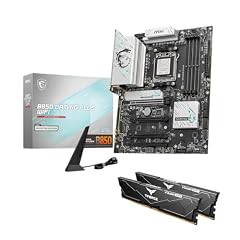
This MSI B850 GAMING PLUS WIFI supports AMD Ryzen 9000 and 7000 processors on AM5, with DDR5 memory up to 8200+ MT/s (OC). It includes built-in WiFi and comes in an ATX form factor.
Pros
- Supports Ryzen 9000 and 7000 series
- DDR5 memory overclocking up to 8200+ MT/s
- Built-in WiFi
- ATX form factor from MSI
Cons
- No PCIe 5.0 M.2 or GPU slots stated in the listing
- Ethernet speed not stated
- No USB4 claim
Good fit if
- Users building a Ryzen 9000 system with high-speed DDR5
- Gamers who want a reliable MSI board with WiFi
Skip if
- You need PCIe 5.0 for the fastest GPUs
- You plan to use multiple M.2 drives at max speed
Verdict: A solid AM5 option for Ryzen 9000 with strong memory overclocking headroom.
6 Best for LGA1851 in white

This NZXT N9 Z890 is a white ATX board for Intel LGA 1851 socket, designed for Intel Core Ultra processors. It offers DDR5 support and a clean aesthetic from a well-known case maker.
Pros
- White PCB and heatsinks for a themed build
- Supports Intel LGA 1851 CPUs
- DDR5 memory support
- ATX form factor
Cons
- Wi-Fi version not stated in the listing
- No PCIe 5.0 or M.2 count mentioned
- Network controller not specified
Good fit if
- PC builders who want a white Motherboard for an Intel Core Ultra build
- Users who prioritize aesthetics and brand name for cases
Skip if
- You need specific high-speed Ethernet or Wi-Fi
- You prefer a board with more explicitly listed expansion slots
Verdict: A stylish LGA1851 board for those building a white Intel system.
7 Best budget AM5 with WiFi

ASRock B850 Steel Legend WiFi AMD AM5 ATX Motherboard
- Socket
- AM5
- Form factor
- ATX
- Memory type
- DDR5
$169.99 price as of 2026-10-07 05:30 UTC (Details)
The ASRock B850 Steel Legend WiFi supports AMD Ryzen 9000, 8000 and 7000 series on AM5, with DDR5 memory up to 8000+ (OC). It includes WiFi and comes in an ATX form factor at a competitive spec level.
Pros
- Supports all Ryzen 9000/8000/7000 series
- DDR5 up to 8000+ (OC)
- Built-in WiFi
- Steel Legend series known for durability
Cons
- No USB4 or Thunderbolt stated
- PCIe 5.0 not claimed in the listing
- Only one M.2 slot mentioned in the name
Good fit if
- Budget AM5 builders who want WiFi and DDR5 overclocking
- Gamers using Ryzen 7000 or 9000 CPUs
Skip if
- You need multiple M.2 slots or PCIe 5.0
- You plan to use a high-end GPU that benefits from PCIe 5.0
Verdict: A cost-effective AM5 board with WiFi and strong memory support.
8 Best for heavy workstation use

ASUS Pro WS W880-ACE SE Intel® Core™ Ultra Processor
- Socket
- LGA1851
- Form factor
- ATX
- Memory type
- DDR5
$449.99 price as of 2026-10-07 05:30 UTC (Details)
This ASUS Pro WS W880-ACE SE supports Intel Core Ultra (Series 2) on LGA 1851 in an ATX form factor. It has 8+1+2+2 power stages and PCIe support, designed for stability in long workloads.
Pros
- 8+1+2+2 power stages for robust delivery
- Supports Intel Core Ultra (Series 2)
- ATX form factor with workstation heritage
- PCIe support for multiple expansion cards
Cons
- No WiFi or Ethernet speed stated in the listing
- Limited M.2 slots unless specified
- No premium gaming features like RGB or audio codec
Good fit if
- Content creators who also game
- Users who need a reliable board for CPU-heavy tasks and occasional gaming
Skip if
- You want built-in wireless networking
- You need the latest gaming-specific features like WiFi 7 or 5GbE
Verdict: A stable LGA1851 platform for professional use with gaming capability.
9 Best for Ryzen 9000/8000/7000 with high power phases

GIGABYTE X870E AERO X3D Dark Wood AMD AM5 ATX Motherboard
- Socket
- AM5
- Form factor
- ATX
- Memory type
- DDR5
$499.99 price as of 2026-10-07 05:58 UTC (Details)
The GIGABYTE X870E AERO X3D Dark Wood supports Ryzen 9000, 8000 and 7000 series on AM5 with a 16+2+2 power stage design. The name suggests optimized support for X3D CPUs.
Pros
- 16+2+2 power stages
- Supports Ryzen 9000, 8000 and 7000
- DDR5 memory support
- ATX form factor
Cons
- No explicit PCIe 5.0 or M.2 count in the listing
- Wi-Fi and Ethernet not stated
- Limited details on USB connectivity
Good fit if
- Users building a Ryzen X3D system for gaming
- Those who want robust power delivery for overclocking
Skip if
- You need specific high-speed networking or many M.2 slots
- You prefer a board with full connectivity specs listed
Verdict: A strong AM5 board for Ryzen gaming with generous power delivery.
10 Best for LGA1700 with WiFi and DDR5

This MSI MPG Z790 Edge WiFi Gaming supports Intel 12th, 13th and 14th Gen processors on LGA1700, with DDR5, PCIe 5.0 and M.2 slots. It includes WiFi and is designed for gaming.
Pros
- Supports 12th, 13th and 14th Gen Intel
- DDR5 and PCIe 5.0
- Built-in WiFi
- Gaming-oriented design from MSI
Cons
- Limited M.2 count unless specified
- No USB4 or 5GbE
- Older socket compared to LGA1851
Good fit if
- Users building an Intel 14th Gen gaming rig
- Those who want a reliable mid-range Z790 with WiFi
Skip if
- You plan to upgrade to Intel Core Ultra in the future
- You need the latest connectivity like WiFi 7
Verdict: A dependable LGA1700 gaming board with PCIe 5.0 and WiFi.
11 Best budget LGA1700

The ASRock B760 Pro RS supports 14th, 13th and 12th Gen Intel on LGA1700, with DDR5 up to 7200+ (OC), PCIe 5.0 and 2.5G LAN. It provides a solid foundation at a competitive spec level.
Pros
- Supports 14th, 13th and 12th Gen Intel
- DDR5 up to 7200+ (OC)
- PCIe 5.0 and 2.5G LAN
- ATX form factor
Cons
- No built-in WiFi
- No USB4 or Thunderbolt
- 10+1+1 power stages, lower than some premium boards
Good fit if
- Budget-conscious Intel builders who want PCIe 5.0
- Users who prefer a wired network connection
Skip if
- You need WiFi without adding a card
- You plan heavy overclocking that requires more power stages
Verdict: A cost-effective LGA1700 board with key gaming features.
12 Best for AM5 with WiFi 7 and 5Gb LAN

ASUS ROG Strix X870E-A Gaming WIFI7 NEO AM5 ATX Motherboard
- Socket
- AM5
- Form factor
- ATX
- Memory type
- DDR5
$422.99 price as of 2026-10-07 05:30 UTC (Details)
This ASUS ROG Strix X870E-A Gaming WiFi7 NEO features AM5, DDR5, WiFi 7, 5Gb LAN, PCIe 5.0, four M.2 slots and two USB4 ports. It offers a comprehensive set of modern connections.
Pros
- WiFi 7 and 5Gb LAN
- Four M.2 slots for storage expansion
- PCIe 5.0 and USB4
- ROG Strix series known for gaming features
Cons
- No explicit power stage count given
- Higher-end price point without stated extra features
- Only two USB4 ports (per listing name)
Good fit if
- Gamers who want the latest wireless and wired networking
- Users building a multi-NVMe AM5 system
Skip if
- You are on a tight budget
- You do not need WiFi 7 or 5GbE
Verdict: A premium AM5 board with fast connectivity and plenty of M.2 slots.
13 Best for quad M.2 on LGA1700

GIGABYTE Z690 AORUS Ultra
- Socket
- LGA1700
- Form factor
- ATX
- Memory type
- DDR5
$340.19 price as of 2026-10-07 05:58 UTC (Details)
This GIGABYTE Z690 AORUS Ultra supports LGA1700 Intel CPUs, with DDR5, four M.2 slots, PCIe 5.0, USB 3.2 Gen2x2 Type-C, WiFi 6 and 2.5GbE. It provides ample storage options for a gaming library.
Pros
- Four M.2 slots for multiple NVMe drives
- PCIe 5.0 and DDR5 support
- WiFi 6 and 2.5GbE LAN
- USB 3.2 Gen2x2 Type-C
Cons
- WiFi 6 rather than WiFi 7
- Older Z690 chipset (still supports 12th/13th/14th Gen)
- Power stages not stated
Good fit if
- Users who need many M.2 SSDs for game libraries
- Intel builders on a slightly older but still capable chipset
Skip if
- You want the latest Z890 or B860 chipset features
- You require WiFi 7
Verdict: A storage-focused LGA1700 board with four M.2 slots and solid connectivity.
14 Best budget LGA1851 with WiFi

This MSI PRO Z890-S WiFi White supports Intel Core Ultra (Series 2) on LGA1851, with DDR5 memory and built-in WiFi. It is a full ATX board with a white aesthetic and a clear product name.
Pros
- Supports Intel Core Ultra (Series 2)
- DDR5 memory support
- Built-in WiFi
- ATX form factor in white
Cons
- No PCIe 5.0 or M.2 count stated in the listing
- Ethernet speed not specified
- Limited gaming-specific features announced
Good fit if
- Users building a first Intel Core Ultra system
- Those who want a white board with WiFi at a moderate spec level
Skip if
- You need the highest bandwidth for a top-end GPU
- You want explicit M.2 or PCIe 5.0 details
Verdict: An entry-level LGA1851 board with WiFi for new Intel builds.
Specifications side by side
| # | Motherboard | Socket | Form factor | Memory type |
|---|---|---|---|---|
| 1 | ASUS ROG Maximus Z790 Hero WiFi6E LGA 1700(Intel 14th | LGA1700 | ATX | DDR5 |
| 2 | Supermicro H14SSL-NT AMD EPYC Single Socket SP5 DDR5 ATX Motherboard | SP5 | ATX | DDR5 |
| 3 | Mother Board Fit for ASRock X670E Steel Legend Motherboard X670 Support | AM5 | ATX | DDR5 |
| 4 | GIGABYTE X870 AORUS Infinity AMD AM5 LGA 1718 Motherboard | LGA1718 | ATX | DDR5 |
| 5 | MSI B850 GAMING PLUS WIFI Motherboard | AM5 | ATX | DDR5 |
| 6 | NZXT N9 Z890 | LGA1851 | ATX | DDR5 |
| 7 | ASRock B850 Steel Legend WiFi AMD AM5 ATX Motherboard | AM5 | ATX | DDR5 |
| 8 | ASUS Pro WS W880-ACE SE Intel® Core™ Ultra Processor | LGA1851 | ATX | DDR5 |
| 9 | GIGABYTE X870E AERO X3D Dark Wood AMD AM5 ATX Motherboard | AM5 | ATX | DDR5 |
| 10 | MSI MPG Z790 Edge WiFi Gaming Motherboard | LGA1700 | ATX | DDR5 |
| 11 | ASRock B760 Pro RS ATX Motherboard | LGA1700 | ATX | DDR5 |
| 12 | ASUS ROG Strix X870E-A Gaming WIFI7 NEO AM5 ATX Motherboard | AM5 | ATX | DDR5 |
| 13 | GIGABYTE Z690 AORUS Ultra | LGA1700 | ATX | DDR5 |
| 14 | MSI PRO Z890-S WiFi White Motherboard | LGA1851 | ATX | DDR5 |
How the picks were chosen
We started with the full catalogue of motherboards and isolated those whose listings identify them for gaming use. That pool, as delivered to the guide, holds 14 current ATX boards after near-duplicate listings were folded. Every pick is chosen for gaming compatibility, and we kept boards that cover the sockets a current build is likely to use: Intel LGA1700, Intel LGA1851, AMD AM5 and AMD SP5 for EPYC. We gave preference to established makers and to new units, and we favored listings that state useful gaming specs: PCIe 5.0, DDR5, M.2 slot count, power stages, Ethernet and Wi-Fi generation. Prices on this page are read live from the store listing at the time shown, so cost is never part of the ranking. No unit in this guide has been tested or benchmarked by our staff; all specifications come from the seller's listing or the manufacturer's published information.
Picking the right one for you
Match the socket to your CPU
The motherboard's socket determines which processors it can accept. Intel LGA1700 boards in this list work with 12th, 13th and 14th Gen Intel Core CPUs. LGA1851 is the newer socket for Intel Core Ultra processors. On the AMD side, AM5 boards support Ryzen 7000, 8000 and 9000 series, while the SP5 socket fits AMD EPYC server chips. Check your CPU's socket before choosing a board; they are not interchangeable.
Look at power delivery for your CPU
Power stages (often labeled as something like "20+1") help deliver clean power to the processor. A board with more power stages is generally better suited for high-end or overclocked CPUs, but the exact requirement depends on the CPU's power draw. For a flagship Intel or AMD chip, boards with 16 or more power stages, like the GIGABYTE X870E AERO, are listed here. If you use a mid-range CPU, a simpler design like the ASRock B760 Pro RS may be enough.
Choose the memory type and speed
All boards in this list support DDR5 memory. The maximum supported speed varies, with some listings noting overclockable speeds such as 8000+ or 8200+ MT/s. If you plan to run memory at high speeds, check that the board's memory slots and BIOS support that speed. Faster memory can help in CPU-bound games, but the gain is often modest compared to the GPU.
Count M.2 slots and PCIe lanes
Gaming and content creation often require multiple fast SSDs. M.2 slots let you install NVMe drives directly on the board, and PCIe 5.0 support provides the bandwidth for the fastest drives. In this list, the GIGABYTE Z690 AORUS Ultra has four M.2 slots, while the ASUS ROG Strix X870E-A also offers four. Other boards have fewer, so consider how many games and files you need to store.
Check network and USB options
A built-in Wi-Fi adapter saves you from buying a separate card, and the standard matters: WiFi 6 is common, while WiFi 7 is the newest, offering higher throughput and lower latency in compatible networks. Wired Ethernet is still useful; 2.5GbE and 5GbE are faster than standard gigabit. USB4 provides high-speed external connections for storage and displays, and the USB4 spec is built on Thunderbolt technology. Consider which devices you'll connect and how many USB ports you need.
Verify the form factor fits your case
All picks here are ATX boards, which are the most common size for gaming desktops. ATX fits in most mid-tower and full-tower cases, but check your case's supported motherboard size before purchase. Some cases are designed for microATX or Mini-ITX, which are smaller, so measure your case's interior and confirm that the ATX dimensions fit.
Questions
What is the difference between LGA1700 and LGA1851 motherboards?
LGA1700 is the socket for Intel 12th, 13th and 14th Gen Core processors. LGA1851 is the newer socket introduced for Intel Core Ultra processors (Series 2). A motherboard with LGA1700 will not work with LGA1851 CPUs and vice versa. Choose the socket that matches your processor.
Do all gaming motherboards support overclocking?
Not all chipsets allow CPU overclocking. Intel Z-series chipsets (like Z790) and AMD X-series (like X670E) typically support CPU overclocking, while B-series and H-series chipsets may have limited support. Check the specific board's features: for example, the ASUS ROG Maximus Z790 Hero and GIGABYTE Z690 AORUS Ultra are Z-series and support overclocking, while the ASRock B760 Pro RS is a B-series board and may have fewer overclocking options.
Why do some motherboards list more power stages than others?
Power stages refer to the number of voltage regulator modules (VRMs) that deliver power to the CPU. More power stages can provide cleaner power and handle higher current draw, which is beneficial for high-end CPUs and overclocking. However, the quality of the components matters too, so a board with fewer stages from a reputable maker may still perform well for your CPU.
Is WiFi 7 worth paying extra for?
WiFi 7 (Wi-Fi CERTIFIED 7) operates on 2.4 GHz, 5 GHz and 6 GHz bands and offers features like 320 MHz channels and multi-link operation, which can provide higher speeds and lower latency than Wi-Fi 6, according to the Wi-Fi Alliance. If you have a compatible router and need maximum wireless throughput, a board with WiFi 7, such as the GIGABYTE X870 AORUS Infinity, may be worth it. For most gamers, WiFi 6 is still adequate, especially with a wired Ethernet connection.
Can I use a server-grade motherboard like the Supermicro H14SSL-NT for gaming?
Yes, you can, but it requires an AMD EPYC processor, which is a server-class CPU. The board has DDR5 memory support and an ATX form factor, so it can fit in a large case. However, EPYC CPUs typically have higher power requirements and lack integrated graphics, so you will need a dedicated GPU. This board is best for users who also need many PCIe lanes for storage or other expansion cards.
Revision notes
- : First published.